This month marks five years since we launched The Philadelphia Center for Gun Violence Reporting. To date we have counted:
1: Reference in the Associated Press Stylebook 4: Research studies published in scientific journals 4: Websites online: PCGVR, AGVR, The Second Trauma & Survivor Connection 12: Colleges and universities host PCGVR events 12: Journalism students provided with PCGVR support 16: Researchers participating in our multidisciplinary collaborative 40: Participants in our community reporting projects 50: Journalists supported to participate in our programs 140: Survivor community experts now available to journalists 150: News media reports illuminating our projects and impact 200: Community participants at our trauma talks with clinical psychologists 250: Editions of this free newsletter distributed 300: People in attendance for our documentary premiere 350: Survivor community participants provided with PCGVR support 400: People in attendance for our panels at summits and national conferences 400: People in attendance at PCGVR journalism training events 500: Printed copies of our reporting toolkit distributed, plus hundreds more online 550: Posts and pages with news and resources published on our web sites 600: People in attendance at our documentary screenings and film festivals 1,600: Newsletter subscribers 3,000: Email contacts 3,600: Bluesky subscribers
And we have done all of this with a very small staff on a very lean budget. With more support, we could hire more people, conduct more activities and produce more impact, sooner. Please consider making a contribution today.
Today marks five years since we launched the Philadelphia Center for Gun Violence Reporting. Here’s a preview from our upcoming 5-Year Impact Report with some of our favorite people.
More milestones coming up this month
• Publishing: “5 Years of Impact,” an extensive multimedia report • Launching: A new look, logo and more accessible website at PCGVR.org • Announcing: Plans to embrace a new, expanded mission • Gathering: Key stakeholders in Philadelphia • Announcing: Our biggest educational event yet
Just imagine
We have come this far with a very small staff on a very lean budget. With more support, we could hire more people, accelerate activities and produce more impact, sooner. Please consider making a contribution today.
• Oronde McClain, PCGVR Survivor Connection director • Abené Clayton, reporter for Guns and Lies in America at The Guardian and co-director of the Association of Gun Violence Reporters • Maxayn Gooden, who has played several key roles at PCGVR • Kelly McBride, Senior Vice President and Chair of Craig Newmark Center for Ethics and Leadership at the The Poynter Institute for Media Studies • Eric Marsh, Sr., PCGVR director of Operations • Cheryl Thompson-Morton, Head of Advisory Programs at the Lenfest Institute for Journalism and Poynter Institute faculty member • Alaina Bookman, Violence Prevention Reporter for Report for America at AL.com • Jennifer Mascia, founding staff member at the The Trace and Guns in America team contributor at CNN
Above: Photographs from the Better Gun Violence Reporting Summit in 2019, by Kriston Jae Bethel.
Nearly five years have passed since we launched the Philadelphia Center for Gun Violence Reporting and nearly seven since we began laying the groundwork. Our first breakthrough came when nearly 250 people attended our Better Gun Violence Reporting Summit at WHYY in 2019, but we are still seeing outcomes.
Here’s how it started: During a panel that brought together local journalists with women bereaved by gun violence, Michelle Kerr-Spry shared that “We don’t know how to live when our children have been murdered… I was literally dying.”
Dr. Dorothy Johnson-Speight of Mothers in Charge followed up, asking: “Why would it take six months to find out there is a group to support her through her grief and pain? And then added: “That should have been reported in the news. That should have been in the newspaper.”
In response, several local news organizations started sharing resources when reporting on gun violence, including CBS 3 News in Philadelphia, WHYY’s Billy Penn news site and NBC 10, which shared a list from Resolve Philly.
We made our own resource page as well at first but then spent the following year working with The Trace to develop their Philadelphia gun violence info hub and sharing it on our home page: Up the Block.
So, we were exceptionally pleased last week when spotting the Gun Violence Resiliency Needs Assessment from the new Resources for Victims of Gun Violence Initiative introduced by the Pennsylvania Commission on Crime and Delinquency, and finding PCGVR on the short list of recommended resources. And we were encouraged to find the takeaways from our Summit — which was attended by at least one current PCCD leader — closely reflected in the text:
“Train journalists on trauma-informed reporting and interactions with violence-affected individuals. These efforts could inform residents about community issues and events, available resources and services when violence occurs, and could encourage readers to provide input into neighborhood issues.“ – Executive Summary
Philadelphia gun violence survivor Dashawn Walker tells his own story in “Unheard,” a new short documentary he co-produced with filmmaker Jessica Griffin, who is also a photojournalist with The Philadelphia Inquirer. Support was provided by the Credible Messenger Reporting Project at the Philadelphia Center for Gun Violence Reporting. Dashawn was also a 2023 intern here at PCGVR, working with staffer and fellow survivor Oronde McClain, who also appears in the film.
In the spirit of other professional organizations such as the Association of Health Care Journalists and the Society of Environmental Journalists, AGVR aims to create a hub for any journalist who’s covered gun violence, whether as a full-time beat or in a breaking and general news capacity. Associate and student members are invited to participate as well.
We encourage reporters and editors to approach gun violence as a systemic problem, paying special attention to root causes such as poverty and disinvestment in education and housing.
We plan to train journalists on how to center survivor voices and perspectives in their reporting, and build relationships with the people closest to the issue, while advancing public health-informed, trauma-aware strategies for interviewing and story production.
We also help reporters stay up-to-date on the latest in gun violence legislation, court cases, litigation and research through our monthly newsletter and our social media channels.
AGVR has been incubated by the Philadelphia Center for Gun Violence Reporting, which formed in 2020 to advance more empathetic, ethical and impactful reporting, and will now operate as a sibling organization.
Sammy Caiola, a Philadelphia-based journalist covering police accountability, sexual violence and mental health/substance use for Kensington Voice.
Abené Clayton, a reporter in the Guardian US newspaper’s California office and currently the lead reporter on the “Guns & Lies in America” series.
Jennifer Mascia, a senior news writer and founding staffer at The Trace.
Alain Stephens, an investigative journalist covering gun violence, extremism, and systemic injustice.
Kaitlin Washburn, the health beat leader for firearm violence and trauma for the Association of Health Care Journalists and an independent journalist based in Chicago.
Paige Pfleger, who covers criminal justice for Nashville’s NPR affiliate, WPLN News.
You can also find us in person today at the Association of Health Care Journalists conference in Los Angeles and join us next month at the Investigative Reporters and Editors conference in New Orleans on June 20!
AGVR is funded in part by the Fund for Safer Future, and has also received support from the Center for Just Journalism, the Joyce Foundation and the Blue Shield of California Foundation.
Follow AGVR on Instagram, visit our home page at AGVR.org and become a member today.
Above, left: Dr. Elinore Kaufman speaks during our Better Gun Violence Reporting Summit in 2019. Right: Dr. Jessica Beard speaks on our panel at the Online News Association national conference in 2023.
Nearly five years ago, from separate hospitals across Philadelphia, the horrifying reality of what we were facing came into focus. What had once been intermittent became incessant: police cars arriving at our doors, with patient after patient who’d been shot.
We were among the first to document the rise in gun violence in 2020, anticipating the heartbreaking years that would follow as the pandemic sowed fear and economic disempowerment. We now see a new wave of apprehension and uncertainty building — and we are bracing ourselves for a return to the distressing rates of gun violence we witnessed five years ago.
But there’s a notable difference between then and now. Five years ago, we were just coming out of a 25-year pause on gun violence research that saw devastating consequences across the United States. Today, we face new attacks on research — with communication blackouts, funding freezes, and cuts at the National Institutes of Health — that threaten to halt the progress we’ve made since 2020, with generational impact.
Gun violence prevention research was advancing rapidly until political obstruction halted progress in the mid-1990s. Aiming to replicate successes in curbing traffic fatalities, researchers had been hopeful the same public health approach — track the problem, identify and test solutions, share findings, and implement what works — could prevent gun violence.
But the research findings that emerged — including that owning a gun increased one’s risk of being murdered in one’s own home — angered lobbyists from firearm manufacturers, leading to the passage of the 1996 Dickey Amendment. While the text of the amendment did not ban research outright, it stipulated that no federal funds be used “to advocate or promote gun control.” Gun violence research dollars within the Centers for Disease Control and Prevention were reallocated, and a shadow was cast over the field of gun violence research for more than two decades.
Sixteen years later, in 2012, Rep. Jay Dickey, who had put forward the 1996 amendment as the point person for the National Rifle Association, coauthored an op-ed reversing his stance, urging more scientific research, and stating the truly “senseless” part of gun violence “is to decry these deaths as senseless when the tools exist to understand causes and to prevent these deadly effects.”
Six months later, President Barack Obama directed the CDC to “conduct or sponsor research into the causes of gun violence and the ways to prevent it.”
But it wasn’t enough.
In 2018, President Donald Trump signed a bill clarifying that the Dickey Amendment did not actually prohibit gun violence research.
Still not enough.
Not until 2021 — the deadliest year on record for gun violence in America, including here in Philadelphia — would we see the first dedicated federal funding for gun violence research in 25 years.
The quarter-century gap resulted in a lack of essential infrastructure to support gun violence research, including expertise, mentorship, basic data, surveillance tools, and that critical public health approach noted above. Palpably present was a reticence by many to embark on research that could upset the same powerful lobby that brought about the Dickey Amendment of the ‘90s.
In recent years we have finally been emerging from our horrific state of inaction. And the rate of gun violence has been decreasing. In Philadelphia, the total number of shooting victims over the last year is down about a third from the same point just before the pandemic. Our renewed research efforts have been working. Lives are being saved. There’s so much reason for hope.
And yet, here we are. Back into chaos, back into economic uncertainty, back into a struggle for our nation’s essential research efforts. But it is a cause worth standing up for.
As trauma surgeons, the suffering of our patients motivates us to do research that will prevent gun violence. We want our research to stop our patients from getting shot; we want it to stop them from dying. And so, even amid these most uncertain times — and perhaps especially during these most uncertain times — we must not stop asking questions, we must not stop searching for solutions.
We must all stand up for science. We must all stand up for our neighbors. We must all stand up for the untold many who will surely die from preventable and treatable diseases — be it cancer, diabetes, or gun violence — if the research that could have saved them simply didn’t get done.
Jessica Beard and Elinore Kaufman are trauma surgeons and public health researchers in Philadelphia. Beard is also a Stoneleigh Foundation fellow and the director of research for the Philadelphia Center for Gun Violence Reporting. Kaufman is the research director for the division of trauma at the University of Pennsylvania and chair of the Pennsylvania Trauma System Foundation research committee.
The Survivor Connection aims to deepen understanding of gun violence
Wednesday, February 26, 2025
FOR IMMEDIATE RELEASE
Philadelphia, PA — A groundbreaking program launched Wednesday by The Philadelphia Center for Gun Violence Reporting promises to facilitate more empathetic, ethical and impactful news reporting in the city by bridging a gap between journalists and the survivor community.
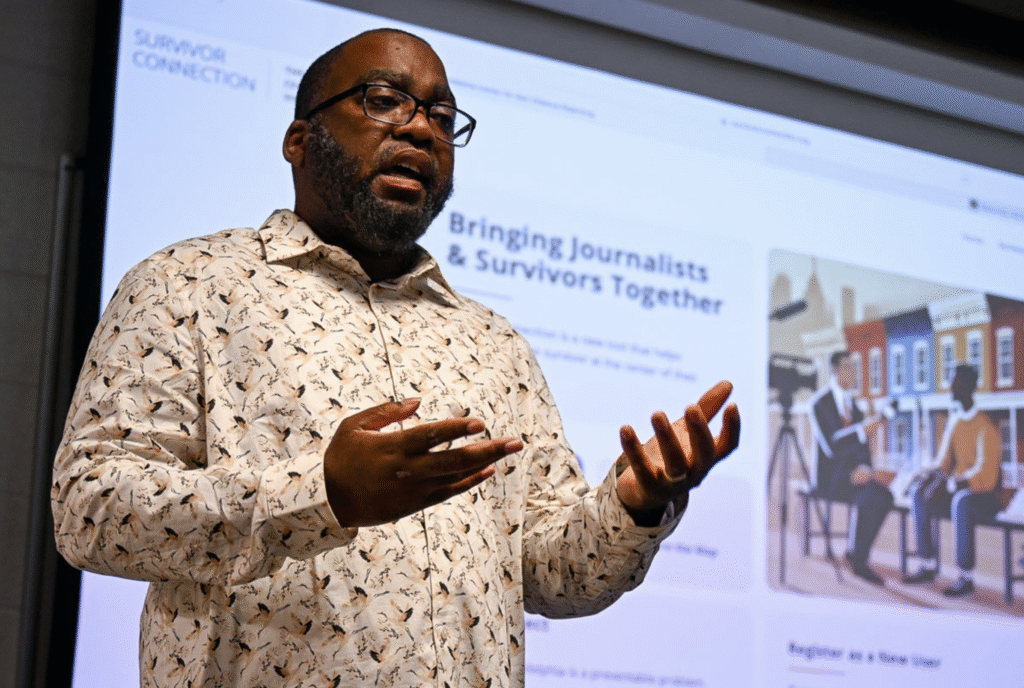
The Survivor Connection database will enable journalists to connect with hundreds of community members with lived experience of gun violence in an effort to broaden the narrative beyond traditional police reporting. Gun violence survivor Oronde McClain leads the program.
Since arriving at PCGVR as a community journalist in 2022, McClain, who was injured in a drive-by shooting when he was 10 years old, has acted as a liaison between journalists and community members and has advocated for better gun violence reporting to audiences across the country.
“For far too long, the people, facts and solutions that should be at the core of conversations about this public health crisis have been passed over, ignored, overlooked, and undervalued,” McClain said. “It’s time to amplify the voices of those impacted most.”
Recent research led by PCGVR Director of Research Dr. Jessica Beard found 12 common elements of news reporting that are harmful to individuals, communities and society at large. Among those elements: narratives that do not include the perspectives of community members and/or firearm-injured people.
The Survivor Connection now includes contact information for more than 120 lived-experience experts, including those who have survived firearm injuries and those who have lost loved ones to gun violence. They have already received introductory training around trauma, media literacy and public health prevention strategies.
Their names and other contextual information are categorized by neighborhood on a secure portal available only to approved journalists who have watched an instructional video. Hundreds more experts have expressed interest in the program.
“I know from my conversations with journalists that they don’t want to cause harm,” McClain said. “This tool will help them tell solutions-forward stories that are healing, humanizing, and impactful.”
About PCGVR: The Philadelphia Center for Gun Violence Reporting collaborates with journalists, researchers and the survivor community to advance more empathetic, ethical and impactful journalism, in Philadelphia and across the United States. Visit: PCGVR.org
Survivor Connection director Oronde McClain previews the web site during a journalism innovation conference at Temple University last fall. Photograph by Kriston Jae Bethel for PCGVR.
Photograph of Eric Marsh courtesy of Derrick Dean Photography
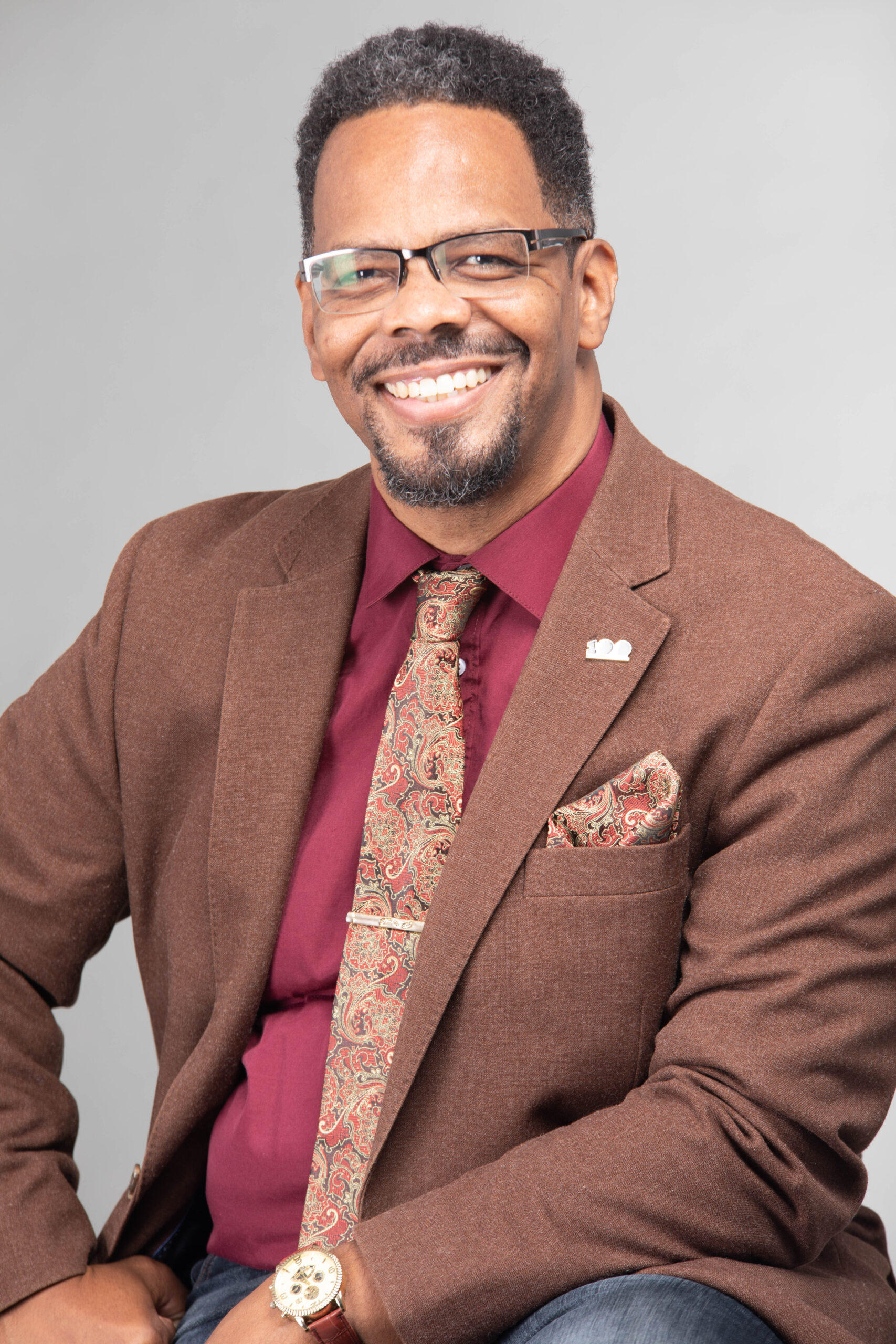
Philadelphia, PA — The Philadelphia Center for Gun Violence Reporting is thrilled to welcome Eric Marsh Sr., a celebrated community organizer and gun violence prevention advocate, into the new role of Director of Operations. The appointment comes as PCGVR, founded in 2020 as a local journalism support organization to advance gun violence prevention reporting, expands its programs — and reach — across the United States.
Marsh brings to the role an impressive track record of leadership, engagement and social change. Most recently, he led the Community and Engagement team at WHYY, where he was instrumental in supporting gun violence prevention journalists and worked alongside the entire newsroom to connect their work with the broader community. Marsh also launched a nationally lauded program that brought hyperlocal journalists into the legacy newsroom to amplify crucial issues and voices. Previously, he led Community Relations for the City of Philadelphia and did outreach with the non-profit Public Health Management Corporation.
“This is deeply personal work for me,” said Marsh, who has lost two loved ones — his cousin and goddaughter — to gun violence. “Gun violence has become an intractable issue in this country and journalists can play a vital role in combatting it. The PCGVR team has made an admirable impact thus far. I am excited to work alongside them to expand that impact even further.”
“Eric Marsh brings the empathy, energy and expertise that is needed to push the needle on this issue,” PCGVR Founder and Director Jim MacMillan said. “We are certain his contributions will impact communities, newsrooms and crucial conversations that will inform gun violence prevention policies across the United States.”
In his new role, Marsh will contribute to the formation of a more stable and sustainable financial model, support the development and launch of an advisory board, work with the staff and stakeholders to update and execute on PCGVR’s strategic plan and collaborate on the creation of an impact measurement framework.
About PCGVR: The Philadelphia Center for Gun Violence Reporting collaborates across the United States with journalists, researchers and the survivor community to advance more empathetic, ethical and impactful journalism. Visit: PCGVR.org
Above: Researchers participating in our collaborative gathered for a meeting at Temple University Hospital in Philadelphia last year. Photo by Kriston Jae Bethel for PCGVR.
New research from our interdisciplinary collaborative addresses media coverage of community gun violence now more clearly defines harmful news reporting practices.
The study included 21 experts — from the gun violence survivor community, journalism practice, and scholarship — who participated in a three-round anonymous survey; an iterative process through which they identified 12 specific harmful elements found in news reports, and then rated those harms across three levels.
The experts agreed on ratings — mild, moderate and severe — for each news content element across individual, community and society levels.
They determined that news stories including graphic content, episodic framing of individual incidents with little or no context, and those which do not explore solutions have the potential to cause severe harm at all three levels.
The panelists found that harmful elements were most detrimental to people who had survived gunshot injuries.
They also concluded that stories only or predominantly including the perspectives of law enforcement, and news reports missing the perspectives of people injured by gun violence or other impacted community members, can cause severe harm on some levels.
The findings are important because community gun violence disproportionately harms people from marginalized racial groups, and news reporting on gun violence can further exacerbate these harms. Reducing harmful news reporting can help address this health disparity and support evidence-based approaches to this urgent public health issue.
Further details are available in the research titled “Defining harmful news reporting on community firearm violence: A modified Delphi consensus study,” which was published in the journal PLOS One on Dec. 18, 2024. A Delphi consensus is a process designed to help a group of panelists reach consensus on a particular topic.
The study’s corresponding author is Dr. Jessica Beard, Director of Research at the Philadelphia Center for Gun Violence Reporting and a Stoneleigh Foundation Fellow. She also serves as Interim Trauma Program Medical Director at Temple University Hospital and Director of Trauma Research at the Lewis Katz School of Medicine at Temple University.
Previous guidelines have been widely accepted for journalists reporting on suicide, mass shootings, sexual assault, abuse, and crimes involving minors.
Identifying specific harmful content in news stories about gun violence and developing reporting guidelines to avoid these elements can illuminate, though not fully resolve, complicated newsroom debates about how journalists can best balance their primary responsibilities to both inform the public and reduce harm.