Since 2021, PCGVR’s multidisciplinary research team, led by trauma surgeon and PCGVR Director of Research Dr. Jessica Beard, has published six peer-reviewed studies that together tell a clear and urgent story: the way local television news covers community firearm violence is systematically harmful, inequitable, and disconnected from the public health realities of the crisis.
PCGVR’s research has defined a new area of scholarly inquiry — creating the tools and frameworks that other researchers, policymakers, and institutions are now building on, and positioning PCGVR as the national leader at the intersection of journalism, public health, and gun violence prevention.
The work produced by PCGVR’s collaborative of scholars, journalists and survivors of community firearm violence — with support from Stoneleigh Foundation and National Institutes of Health — reveal three interlocking themes, each with distinct implications for newsrooms, communities, and future research.
THEME 1
The people most impacted by community firearm violence are further harmed by the way their stories are told.
The earliest study in our body of work was grounded in the experiences of those most affected by community firearm violence. At Philadelphia’s busiest trauma center for firearm injuries, researchers interviewed 26 firearm injury survivors shortly following their injuries. Participants largely felt negative or conflicted about being covered in the news. Half were aware of TV, newspaper or social media coverage of their shooting, yet none had been interviewed by a journalist.
” I would prefer if they (actually interviewed me)…instead of writing it like I’m a nobody.“
– study participant¹
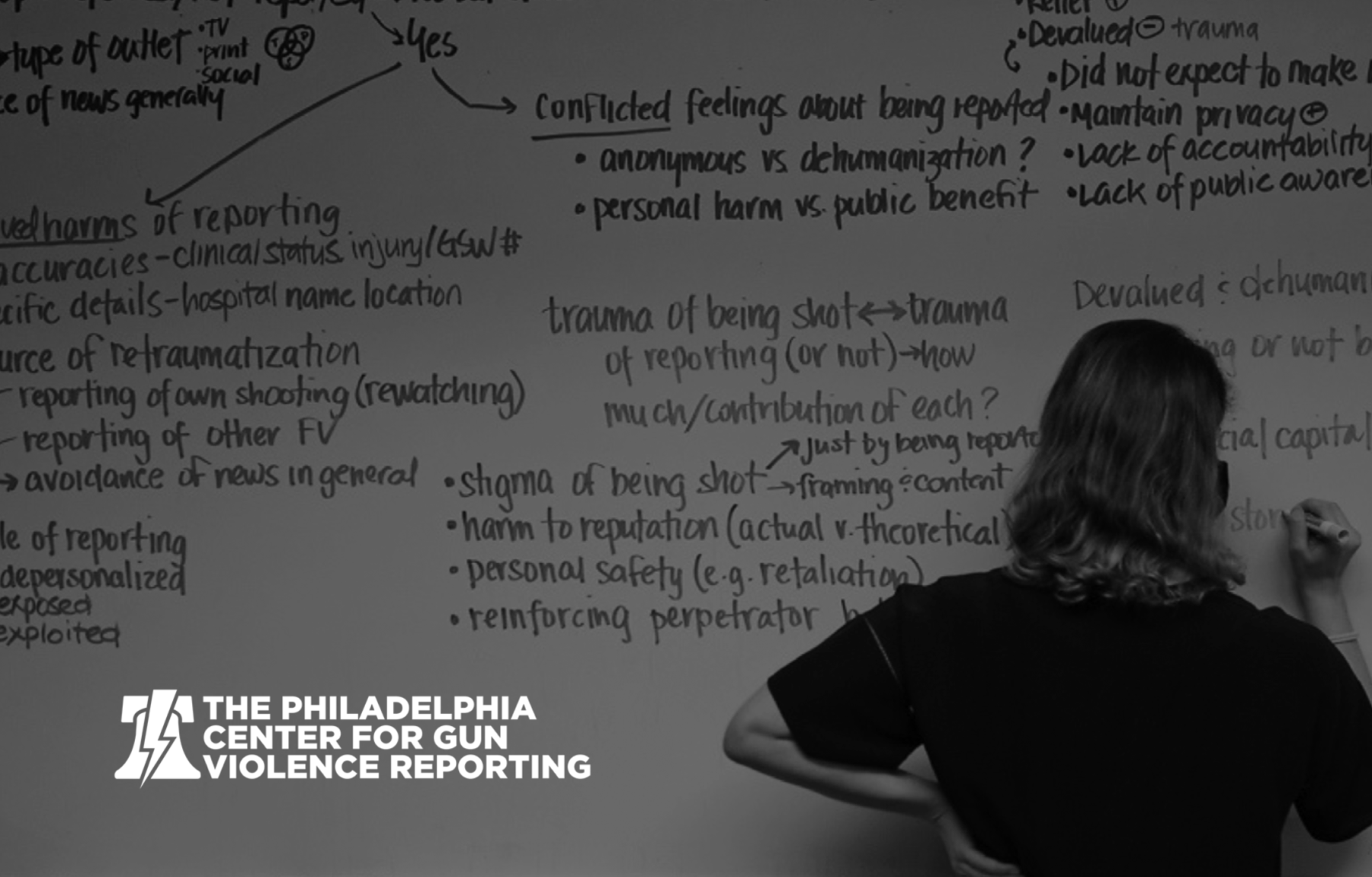
Participants described a range of harms: reliving trauma when viewing coverage, threats to personal safety when details such as hospital name were broadcast, damage to their reputation, and a pervasive sense that their humanity had been erased. They expressed a desire to be treated as people with stories, not data points in a police blotter.
Changing the way community firearm violence is covered is not merely a journalistic best practice, but a matter of preventing further harm.
THEME 2
Harmful content is pervasive and inequitable.
Researchers defined harmful reporting through a process that brought together scholars, journalists, and firearm violence survivors to identify and rate the severity of various news elements that cause harm at the individual, community, and societal levels.²
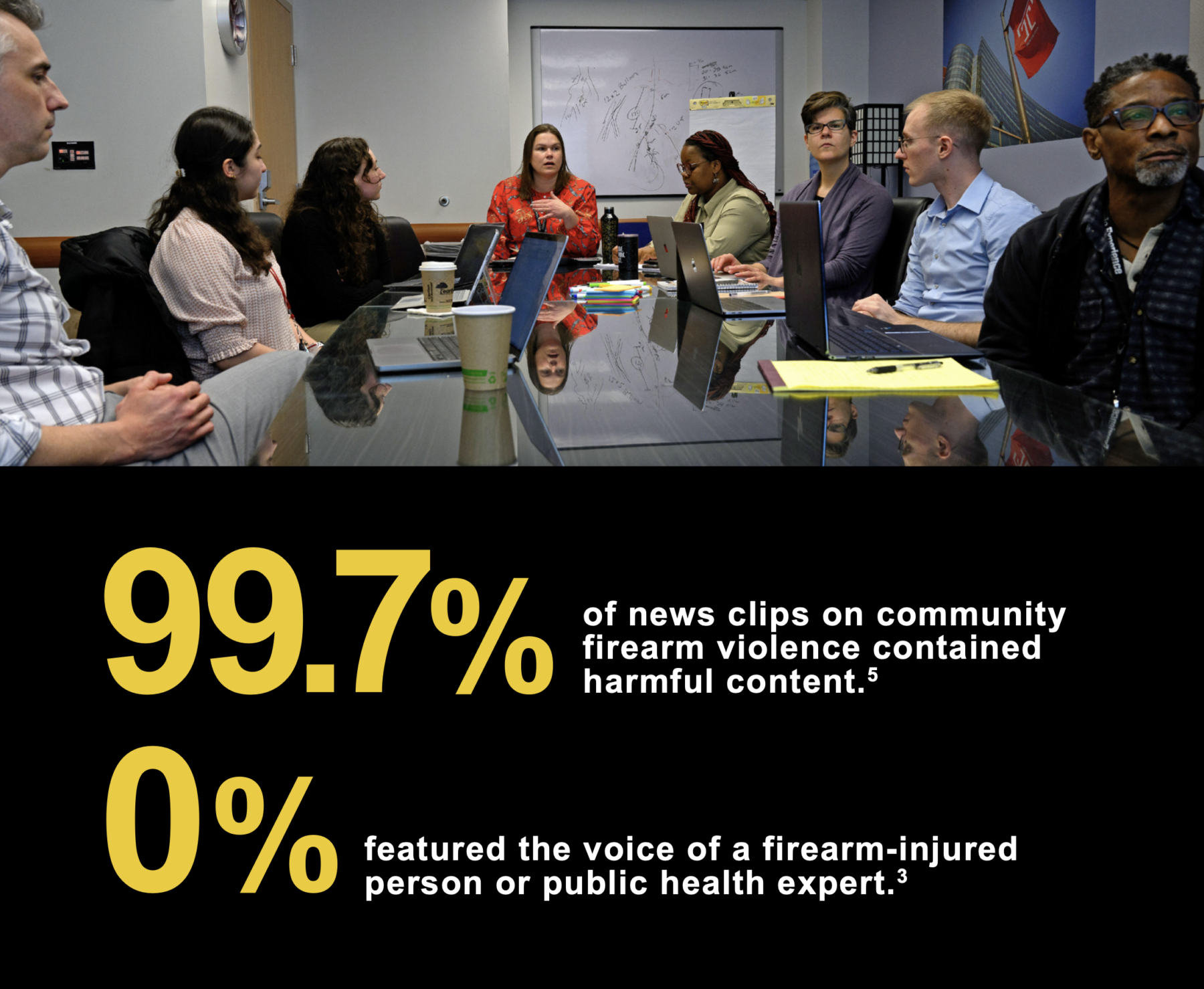
Applying this framework, they found that harmful content is not an occasional lapse; it is the norm. Analyses of hundreds of TV news clips found 84.4%³– 99.7%⁵ ofclips contained harmful content.
In one analysis, 30.3% of clips included graphic and/or explicitcontent⁶, one of the most harmful elements. Black shooting victims and people shot in areas with a higher proportion of Black residents were more likely to have news coverage with graphic content.
Follow-up stories matter. Fatal shootings that include a follow-up story are less likely to contain harmful content.
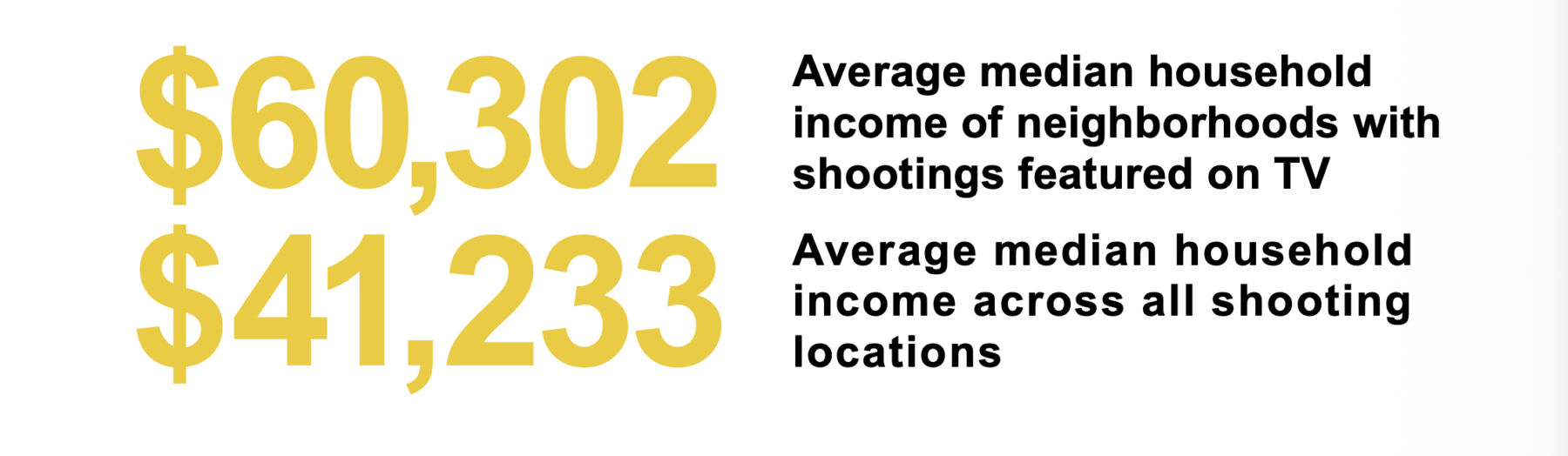
Further, researchers found shootings of children, mass shootings, and shootings in higher-income neighborhoods with lower rates of racialized economic segregation were systematically over-reported — and that harmful reporting directly intersects with the race and socioeconomic characteristics of the victims and communities depicted.⁴
Communities bearing the greatest burden of firearm violence are simultaneously invisible and most subject to harmful portrayals when they do appear.
THEME 3
Public health framing is near non-existent.
Community firearm violence is a public health crisis, but local television news does not treat it that way.
In one of our studies examining local news clips, nearly 80% of stories usedepisodic framing (another study put this number at 93.9%), rather than episodic framing, rather than thematic framing. More than half of the stories contained law enforcement as the predominant source of information. Not one thematic framing. More than half of the stories contained law enforcement as story featured the voice of a public health expert or firearm injured person.³
Framing matters. Episodic stories focus on isolated incidents with surface-level details. Thematic frames — such as with surface-level details. Thematic frames — such as a public health frame — incorporate broader context.
Stories with a Public Health Frame³ include:
• Epidemiologic Context
• Public Health Narrators
• Root Causes
• Solutions
• Public Health Visuals
Episodic stories frame community firearm violence almost exclusively as a criminal justice matter, obscuring root causes, community impacts, and evidence-based solutions that a public health lens illuminates.
A GROWING BODY OF EVIDENCE
From listening to survivors, to defining harm, to measuring its prevalence, our research has built the evidence base that informs PCGVR’s tools, training, and advocacy.
KEY FINDINGS: 26 firearm injury survivors describe the harms of having their stories reported in the news. None interviewed by a journalist. First study to center lived experience of gun violence survivors in media research.
KEY FINDINGS: 21 experts reach consensus on 12 harmful content elements and rate their severity across individual, community, and societal levels. Creates the measurement framework for all subsequent studies.
KEY FINDINGS: 192 clips analyzed: 80% episodic, 84% contain harmful content, 0% feature health professional or survivor voice. Police dominate as sources. Public health lens almost entirely absent.
KEY FINDINGS: 154 TV clips matched to police data reveal over-reporting of child victims, mass shootings, and higher-income neighborhoods. Communities most impacted receive least coverage proportionately.
KEY FINDINGS: 99.7% of clips contain harmful content across all four stations with similar scores, showing the problem is systemic, not isolated to any one newsroom.
KEY FINDINGS: News coverage of Black, adult victims in non-fatal shootings and people shot in areas with a higher proportion of Black residents more likely to include graphic and/or explicit content, two characteristics associated with harm.
This research was funded by the National Institute on Minority Health and Health Disparities f the National Institutes of Health under Award Number R21MD019088.The content is solely the responsibility of the authors and does not necessarily represent the official views of the NIH.
FROM EVIDENCE TO ACTION
Each research finding maps directly to actions that newsrooms, communities, and researchers can take — and to the programs and resources PCGVR has built to support these actions.
Newsrooms: Diversify sources beyond law enforcement, using PCGVR’s Survivor Connection program to connect with lived-experience experts. Practice trauma-informed interviewing and storytelling. Adopt thematic framing that includes root causes, data, and solutions. Eliminate routine inclusion of treating hospital names, gunshot-wound counts, and graphic imagery. Follow up on stories. Use the Better Gun Violence ReportingToolkit as an editorial reference, and our Association of Gun ViolenceReporters for strategies, sources, and peer support.
Communities: Engage with PCGVR’s Survivor Connection program to share your story on your own terms. Advocate for media accountability using our research-backed evidence base. Tell newsrooms when you appreciate their good work, and let them know when there’s something they can improve upon. Partner with future researchers as co-investigators.
Researchers: Replicate these studies in other media markets. Measure the downstream health and policy impacts of coverage patterns. Evaluate intervention effectiveness. Continue centering lived experience in research design. Share your research with the public. Build relationships with journalists. Be available as sources for stories anchored in prevention, solutions, and context.
The evidence is in. The tools are available. The moment to act is now.
RESEARCH TEAM
Iman N. Afif (Temple) I Jessica H. Beard (Temple) I Elizabeth Dauer (Temple) I Evan L. Eschliman (Duke) I Sara F. Jacoby (Penn) I Jim MacMillan (PCGVR) I Jennifer Midberry (Temple) I Tyrone Muns (Temple) I Christopher N. Morrison (Yale) I Raha Raissian (Temple) I Leah Roberts (University of California, Berkeley) I Kallie Palm (MCW) I Laura Partain (Ohio State) I Bach Tong (Temple) I Shannon Trombley (Temple) I Tia Walker (Temple) I Anita Wamakima (Temple) I Siena Wanders (Temple)